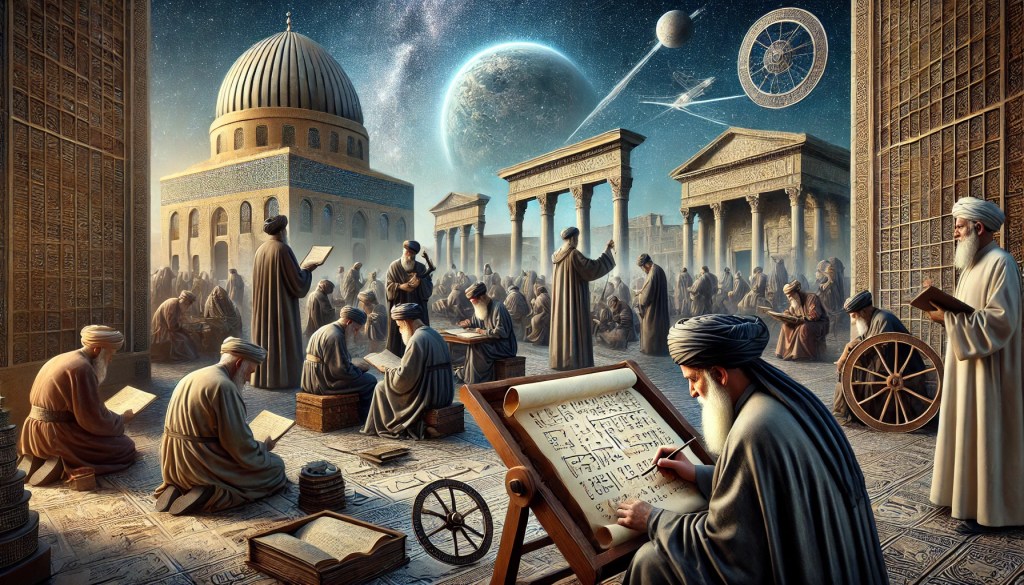
Iraq, historically known as Mesopotamia, has been a cradle of scientific and mathematical innovation. From ancient civilizations to the Islamic Golden Age, Iraqi scholars have made significant contributions that have shaped modern science and mathematics.
Ancient Mesopotamian Contributions
The Sumerians and Babylonians of ancient Mesopotamia developed early forms of mathematics and astronomy. They utilized a base-60 numeral system, which led to the 60-minute hour and 360-degree circle still in use today. Their advancements in geometry and algebra were instrumental in the construction of Ziggurats, irrigation systems, and agricultural planning.
The Babylonian clay tablets, such as the Plimpton 322, contain early examples of trigonometry and quadratic equations, demonstrating advanced mathematical concepts long before Greek mathematicians like Pythagoras.
Islamic Golden Age (8th – 14th Century CE)
During the Islamic Golden Age, Baghdad became a global center for science, mathematics, and philosophy. The establishment of the House of Wisdom in the 9th century facilitated the translation of Greek, Persian, and Indian texts into Arabic, fostering an intellectual revolution.
Notable Iraqi Scholars and Their Contributions
- Al-Khwarizmi (c. 780–850 CE)
- Known as the “father of algebra,” he wrote Al-Kitab al-Mukhtasar fi Hisab al-Jabr wal-Muqabala, which introduced systematic solutions to linear and quadratic equations.
- The term “algebra” is derived from al-jabr, one of the operations he used.
- His name also gave rise to the term “algorithm.”
- Al-Kindi (c. 801–873 CE)
- A polymath who contributed to cryptography, mathematics, and philosophy.
- Introduced Indian numerals to the Islamic world, laying the foundation for modern arithmetic.
- Developed early cryptanalysis techniques still relevant today.
- Thabit ibn Qurra (c. 826–901 CE)
- Made significant discoveries in algebra, geometry, and astronomy.
- One of the first to reform the Ptolemaic system and contributed to the development of calculus.
- Ibn al-Haytham (c. 965–1040 CE)
- Known as the “father of optics,” his Kitab al-Manazir (Book of Optics) introduced the scientific method.
- Proved that light travels in straight lines and developed early camera obscura principles.
- Al-Tusi (c. 1201–1274 CE)
- Developed the Tusi Couple, an essential contribution to the Copernican Revolution.
- Laid the groundwork for modern trigonometry by introducing sine and tangent functions as independent concepts.
Timeline of Key Scientific Achievements in Iraq
- 3000 BCE – Development of the Sexagesimal System by the Sumerians.
- 1800 BCE – Plimpton 322, an advanced Babylonian trigonometry table, is created.
- 762 CE – Foundation of Baghdad as the capital of the Abbasid Caliphate.
- 9th Century – House of Wisdom established in Baghdad, becoming a hub for scientific learning.
- 820 CE – Al-Khwarizmi writes The Compendious Book on Calculation by Completion and Balancing, pioneering algebra.
- 11th Century – Ibn al-Haytham publishes Book of Optics, revolutionizing the understanding of light and vision.
- 13th Century – Al-Tusi develops spherical trigonometry and improves the Ptolemaic planetary model.
How to Study and Understand Iraq’s Scientific Legacy Today
To delve deeper into Iraq’s contributions to science and mathematics:
- Academic Research:
- Explore books and papers discussing Mesopotamian mathematics and Islamic science on JSTOR and Project Gutenberg.
- The Smithsonian Institution features collections on ancient Mesopotamian artifacts and early scientific manuscripts.
- Museums and Exhibitions:
- Visit institutions like The British Museum, which holds Babylonian mathematical tablets, or The Iraq Museum in Baghdad.
- Online Courses and Documentaries:
- Platforms like Coursera and Khan Academy offer courses on the history of mathematics and Islamic scientific achievements.
- Watch documentaries such as BBC’s Science and Islam to learn about the House of Wisdom and its scholars.
 Iraq Travel Tales