
Mesopotamia, often called the “Cradle of Civilization,” was home to some of humanity’s earliest advancements in writing, law, architecture, and science. Located between the Tigris and Euphrates Rivers, this ancient land gave rise to the Sumerians, Akkadians, Babylonians, and Assyrians, whose innovations shaped the foundations of modern society.
Key Contributions of Mesopotamian Civilization
1. The Invention of Writing – Cuneiform
Around 3200 BCE, the Sumerians developed cuneiform, one of the earliest known writing systems. This system, consisting of wedge-shaped marks pressed into clay tablets, was used for record-keeping, trade, laws, and literature. One of the most famous cuneiform texts is the Epic of Gilgamesh, considered the world’s oldest epic poem.
2. The First Legal System – Code of Hammurabi
In 1754 BCE, King Hammurabi of Babylon established one of the first known legal codes—the Code of Hammurabi. This set of 282 laws regulated commerce, family matters, and crime, introducing the principle of “an eye for an eye” as a form of justice. Many modern legal systems still reflect elements of this Babylonian law code.
3. Urbanization and Monumental Architecture
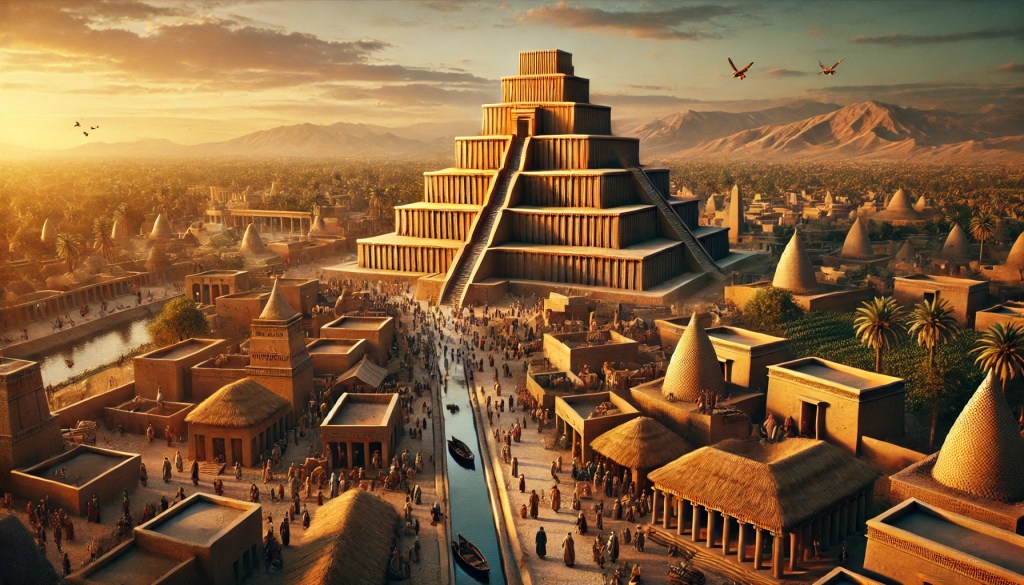
The ancient cities of Ur, Uruk, and Eridu were among the first urban centers in history, featuring massive temples, irrigation systems, and residential districts. The ziggurats – step-pyramids that served as religious and administrative hubs—exemplified Mesopotamian architectural ingenuity.
4. Mathematical and Astronomical Advancements
Mesopotamians pioneered mathematics and astronomy, developing the sexagesimal system (base 60) that gave us the 60-minute hour and 360-degree circle. They also mapped the stars, created early calendars, and tracked celestial events, forming the foundation for later Greek and Islamic astronomical studies.
5. Agriculture and Technological Innovations
To support growing populations, Mesopotamians mastered irrigation, redirecting river water through canals and levees to ensure stable food production. They also invented the plow and the wheel, revolutionizing both farming and transportation.
Timeline of Significant Events in Mesopotamian History
- c. 5400 BCE – Founding of Eridu, one of the earliest known cities.
- c. 3200 BCE – Invention of Cuneiform writing by the Sumerians.
- c. 2334 BCE – Rise of the Akkadian Empire under Sargon the Great, forming one of the first multinational empires.
- c. 1754 BCE – Hammurabi writes his famous legal code.
- c. 626 BCE – The Neo-Babylonian Empire flourishes under King Nebuchadnezzar II, constructing the legendary Hanging Gardens of Babylon.
- 539 BCE – Fall of Babylon to the Achaemenid Persians, marking the end of Mesopotamian independence.
How to Study and Understand Mesopotamia Today
1. Explore Museum Collections
Many Mesopotamian artifacts and tablets are preserved in major institutions like the Iraq Museum, the British Museum, and the Louvre.
2. Take Online Courses
Educational platforms such as Khan Academy and Coursera offer free courses on Mesopotamian history, archaeology, and culture.
3. Read Books and Articles
Books like “The Invention of Yesterday” provide accessible insights into how Mesopotamian innovations shaped the modern world.
4. Follow Archaeological Discoveries
New findings are frequently published by organizations like UNESCO and National Geographic, shedding light on ongoing excavations and restoration efforts.
 Iraq Travel Tales